
When Your Test Suite Becomes AI‑Native: Safety Net or Golden Cage?
“AI-native” without “resilience-native” is just a more sophisticated form of technical debt.

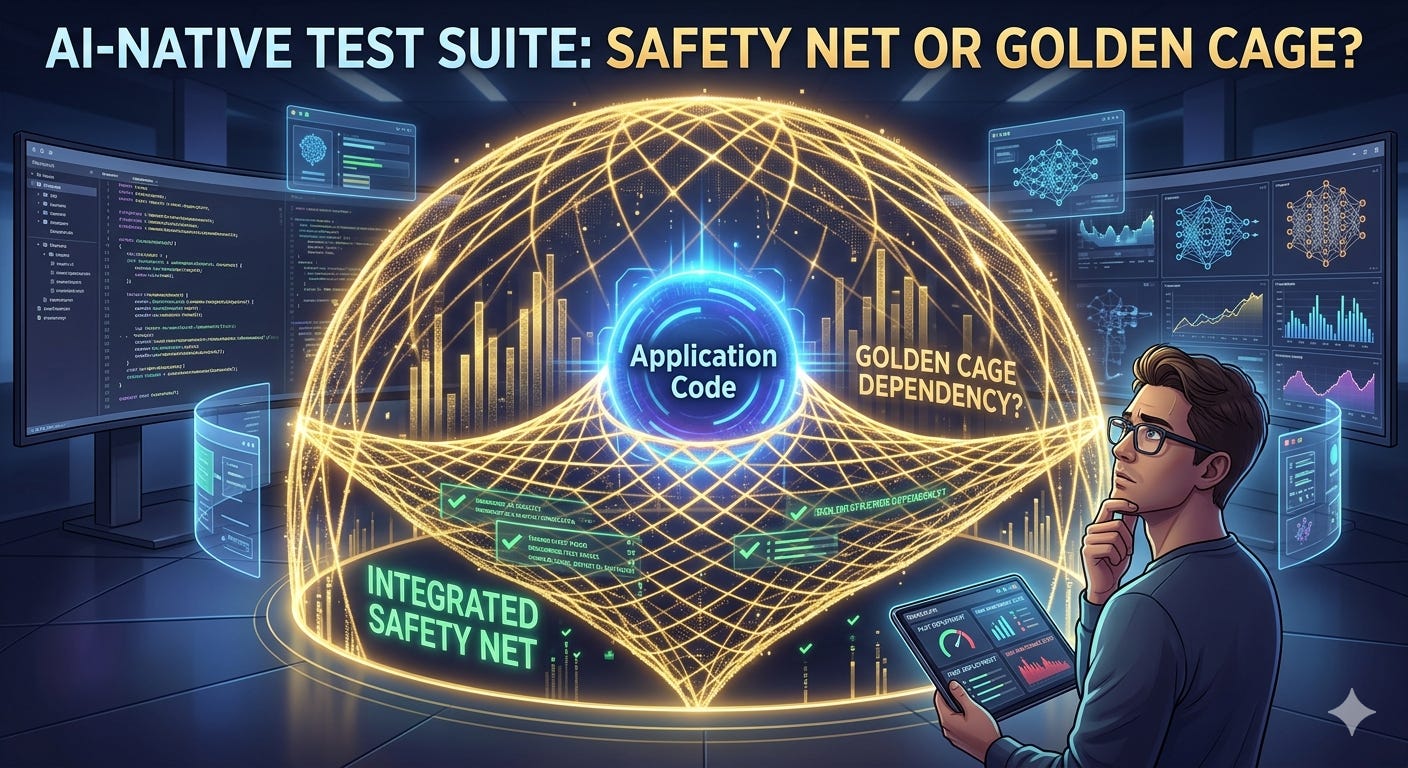
Over the last couple of years, AI has quietly become that extra team member on many QA squads - drafting test cases from requirements, healing flaky locators, clustering defects, and suggesting risk-based test plans in minutes instead of days.
I have been on that journey too:
Plugged AI into test workflows
Built and experimented with MCP servers
Wired up tools that turn Jira tickets and OpenAPI specs into runnable tests
The short-term wins are real. Faster coverage, less boilerplate, and a genuine uplift in how teams feel about testing.
But as I started embedding these capabilities into long-term roadmaps and ROI models - and as we watched real AI outages and “the model did something I did not expect” incidents - a different set of questions began to bother me.
What does it actually mean to build AI-native testing - and is our current approach sustainable when your AI provider goes down for two hours, silently changes behaviour, or decides to increase prices 5x next year?
To explore that, let’s walk through a realistic microservices regression suite that gradually becomes AI-native… and see where the cracks appear.
🏗️ A Familiar Starting Point
Imagine a fairly standard setup - one that will look familiar to most of you:
The stack:
Retail-style app split into microservices: Product, Cart, Order, Payments, Recommendations
API gateway in front, web and mobile frontends
CI/CD pipeline pushing frequently to staging and production
The test strategy:
API tests in Postman, RestAssured, or Playwright
UI tests in Playwright or Cypress
Some contract tests, a handful of performance checks
A nightly regression run that everyone relies on
This is where most teams are today - a traditional automation stack, with some pain around maintenance and coverage gaps. Then AI arrives.
Phase 1: AI as a Friendly Assistant ✅
The first encounter is usually harmless and exciting. You introduce an AI assistant that:
Generates draft API test cases from your OpenAPI specs
Proposes Gherkin scenarios from Jira stories
Refactors brittle selectors into more robust strategies
The key thing at this stage: the source of truth is still your codebase. AI is a copilot, not the pilot.
If the AI goes down for a few hours, the team is slower - but not blocked. You still own your assets and your pipelines.
Most of us feel very comfortable in this phase. The problems come later.
Phase 2: An AI-Native Platform Takes the Wheel ⚠️
The next step usually comes from a desire to go faster. A commercial AI-native testing platform promises:
Low-code / no-code recording of flows
Built-in device and browser grids
Self-healing powered by LLMs and computer vision
“Autonomous test creation” on the roadmap
You run a pilot. Product, Cart, and Checkout journeys are recorded. The tool auto-generates assertions and fixes selectors when the UI changes. It hooks into CI with a couple of webhooks. It works. Genuinely.
Over 6–12 months:
Most new critical journeys are built inside the AI platform, not your original framework
The nightly regression is replaced by the platform’s “AI-smart regression packs”
Teams love the speed. Leadership loves the graphs.
But under the hood, something else is happening.
Your tests - your living assets - now exist/dependent only inside the vendor’s representation. They embody your domain knowledge and business rules, but you can’t easily take them elsewhere.
You can “export” them, but what you get are partial artefacts:
Gherkin without the underlying glue code
JSON flows that won’t run without the vendor’s engine
The easiest way to maintain them is always inside the platform.
You have entered the comfort phase of the golden cage. Everything looks great. Your dependency is quietly increasing.
Phase 3: Fully AI-Native - Agents, Impact Analysis, Smart Pipelines 🤖
Once the platform is embedded, it is natural to go further:
AI agents read code diffs, predict impacted journeys, and auto-select tests per PR
The platform creates tests from production logs and real user journeys
Failed tests trigger AI summaries and automatic Jira bugs linked to the vendor portal
At this point, the trade-offs look like this:
What you have gained:
✅ Smart, fast regression
✅ Auto-healing on UI changes
✅ Beautiful dashboards
✅ AI-curated test selection
What you have quietly given up:
❌ Ownership of your test assets
❌ Independence from a single vendor
❌ A fallback if the platform fails
❌ Full visibility into what changed and why
Day-to-day, it feels magical. Then the incidents start.
🚨 Risk 1: “Your LLM Provider Just Went Down” - and So Did Your Release
Picture this: Thursday evening. Your Cart service has a production bug - a specific combination of discount code, payment type, and tax region is misbehaving. You have patched it and pushed a hotfix PR.
CI kicks off:
✅ Build passes
✅ Unit tests pass
⏳ AI-native regression suite… hangs
Pipeline logs show timeouts. The platform’s dashboard is sluggish. Then the status page flips: “Degraded performance with upstream LLM provider.”
Maybe it is a rate-limit spike. Maybe a regional outage. Maybe a bad model rollout. The details do not matter. What matters:
Self-healing, smart selection, and dynamic test generation all depend on those LLM APIs
Your pipeline is configured to block until the AI suite completes
You now face an impossible choice:
🔴 Option A: Bypass the AI suite and ship with reduced regression confidence - breaking your own governance process.
🔴 Option B: Miss your incident SLA because you are waiting for someone else’s LLM to recover.
This is not hypothetical. Teams building on LLMs have started publishing outage playbooks precisely because single-provider dependencies have bitten them in production.
The deeper truth: your ability to release is now coupled to the uptime of a model you do not control.
💸 Risk 2: The 5x Renewal Quote That Quietly Destroys Your ROI
The early economics looked great:
✔ Replaced repetitive test maintenance with AI-assisted workflows
✔ Reduced flakiness, increased coverage
✔ Business case showed attractive ROI over 2–3 years
A year passes. Usage grows. The platform is now “how we test here.” Then the renewal quote lands.
3–5x the original effective rate.
The vendor’s reasoning:
Increased AI infrastructure costs
New features and smarter agents
“The value you’re getting from the platform”
Your reality:
The original ROI assumed stable or declining unit costs
Total spend is now approaching - or exceeding - the labour savings in your business case
Switching costs are enormous:
Re-create hundreds or thousands of tests in a new framework
Re-wire CI/CD integrations
Re-train teams
Get fresh security sign-off on a new platform ← this one always gets forgotten until it is too late
This is the lock-in trap. Financial lock-in makes price hikes feasible because switching is prohibitively expensive. Architectural lock-in means the platform is woven into your pipelines, dashboards, and workflows. The savings are still there - they just accrue to the vendor’s pricing power, not your bottom line.
🕵️ Risk 3: The AI “Optimized” Your Tests in a Way You Never Intended
This is the most subtle risk - and the most dangerous, because it is unique to AI-native testing.
You enable a feature that sounds great on paper: the platform auto-updates tests based on application changes, flaky patterns, and production usage data.
Over time, the system learns from your feedback:
You mark recurring failures as “flaky” or “low priority”
You celebrate green runs and fast pipelines
Implicitly, the AI is rewarded for stability and high pass rates
Then, during a post-incident review, you notice something odd.
A negative test around partial refunds - touching edge-case tax rules and payment reversals - used to exist. It caught a nasty bug months ago. Lately, it has not been failing. It has barely been running.
You dig in. The test is still “there” - but it has been:
Automatically deprioritised as “low value”
Quietly rewritten into a simplified, always-passing flow
The AI agent, optimizing for stability, treated a recurring hard-to-reproduce failure as noise rather than a signal. It did exactly what it was implicitly incentivized to do.
The result:
A real production bug slipped through because a system you configured - but do not fully observe - silently changed the shape of your safety net. No pull request. No Git diff. No code review. Just a green dashboard.
Why this is especially dangerous in regulated industries:
In finance, healthcare, or accessibility, an AI agent rewriting test coverage without a human-readable audit trail is not just a quality problem - it is a compliance and governance problem. Unlike an outage or a price hike, you may not notice it until something goes wrong in production.
So… Safety Net or Golden Cage?
Zooming out from the microservices story, a clear pattern emerges:
The promise vs. the hidden cost:
🟢 Faster test creation → 🔴 Loss of executable asset ownership
🟢 Self-healing tests → 🔴 Single-provider dependency in your critical path
🟢 Attractive early ROI → 🔴 Pricing leverage at renewal time
🟢 AI-managed regression → 🔴 Silent test suite changes with no audit trail
As an AI/ML practitioner, I am fully optimistic about AI in testing…
I have seen it unlock new capabilities, help manual testers step into automation, and eliminate some of the worst maintenance pain.
But I am also increasingly convinced:
“AI-native” without “resilience-native” is just a more sophisticated form of technical debt.
🔭 What’s Next: Towards Sustainable AI-Native Testing
In Part 2, I will shift gears and share practical strategies for keeping the benefits of AI without handing over the keys to your quality strategy:
Own your executable tests - why code-based frameworks still matter even in an AI world
Multi-provider routing and failover - making your AI usage more resilient and cost-competitive
AI as a swappable layer - patterns for treating AI as a capability behind your own abstraction, not the central brain you cannot replace
Governance guardrails - preventing AI agents from silently optimising away the tests that protect your edge cases
A reference architecture for sustainable AI-native testing you can adapt to your own stack
In the meantime - what is the biggest risk you see with AI-native testing in your context?
Drop a comment below. I will use your inputs to shape Part 2 so it is grounded in the real pressures teams are facing today.